Selected Events

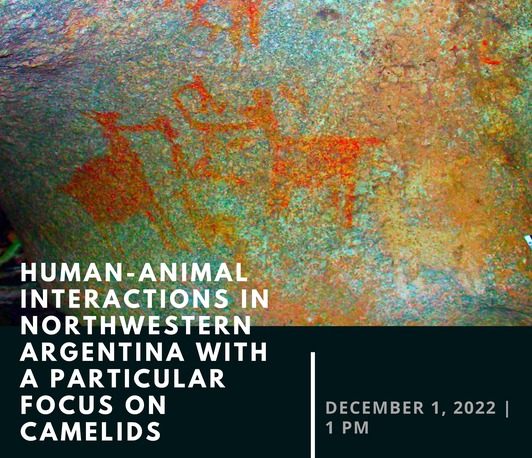
Guest Talk: Human-Animal Interactions in Northwestern Argentina with a Particular Focus on Camelids

  • Date: Dec 1, 2022
  • Time: 01:00 PM - 02:00 PM (Local Time Germany)
  • Speaker: Dr. Enrique Moreno
  • Location: Hybrid
  • Room: Villa V14 and Zoom
  • Host: Department of Archaeology
  • Contact: zucarelli@shh.mpg.de
This talk will review the historical changes in the relationship between human populations and South American camelids in Northwest Argentina (NWA), with special emphasis on transformations after the Spanish conquest, through two study cases. [more]

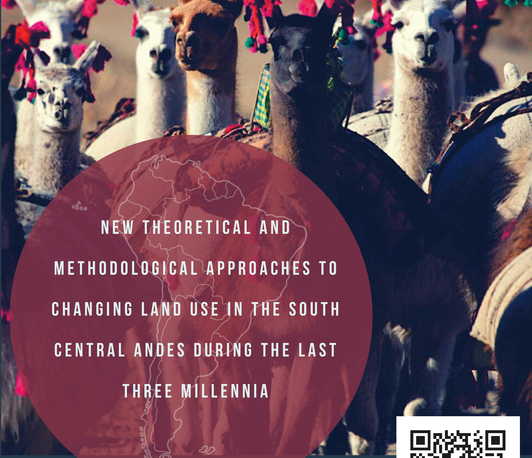
Workshop: New theoretical and methodological approaches to changing land use in the South Central Andes during the last three millennia

  • Date: Nov 28, 2022
  • Time: 09:00 AM - 08:00 PM (Local Time Germany)
  • Speaker: Various
  • Location: MPI of Geoanthropology
  • Room: Villa V14
  • Host: Department of Archaeology
  • Contact: zucarelli@shh.mpg.de
Format: 30 min presentations + 10 min QA [more]

Long Night of the Sciences

  • Date: Nov 25, 2022
  • Time: 06:00 PM - 11:59 PM (Local Time Germany)
  • Location: MPI of Geoanthropology

Public Talk Noble Gespräche: „Das Anthropozän - planetare Krise und Herausforderung für die Wissenschaften” (talk in German)

  • Date: Nov 17, 2022
  • Time: 05:00 AM (Local Time Germany)
  • Speaker: Prof. Dr. Ricarda Winkelmann & Prof. Dr. Dr. h.c. mult. Jürgen Renn
  • Location: Beutenberg Campus, Hans-Knöll-Str. 1, 07745 Jena
  • Room: Hörsaal Abbe-Zentrum Beutenberg
  • Host: Beutenberg Campus e.V.
Prof. Winkelmann und Prof. Renn erläutern in ihrem Vortrag, welche Bedeutung das Anthropozän für die Wissenschaft haben wird, insbesondere in Bezug auf das Verhältnis von Gesellschafts- und Naturwissenschaften. Dabei greifen sie die Frage auf, welche neuen Forschungsansätze und -methoden notwendig sind, um den planetaren Herausforderungen zu begegnen, zu denen gleichermaßen der Klimawandel, der Biodiversitätsverlust und Umweltschäden zu zählen sind. [more]

Towards a Systems-Based Historical Science

  • Date: Nov 16, 2022
  • Time: 10:30 AM - 12:30 PM (Local Time Germany)
  • Speaker: Ricardo Fernandes
  • Location: Online
  • Host: Jürgen Renn
  • Contact: rennoffice@mpiwg-berlin.mpg.de
The Max Planck Institute for the History of Science is pleased to host Ricardo Fernandes for a hybrid lecture on the topic: “Towards a systems-based historical science.” [more]

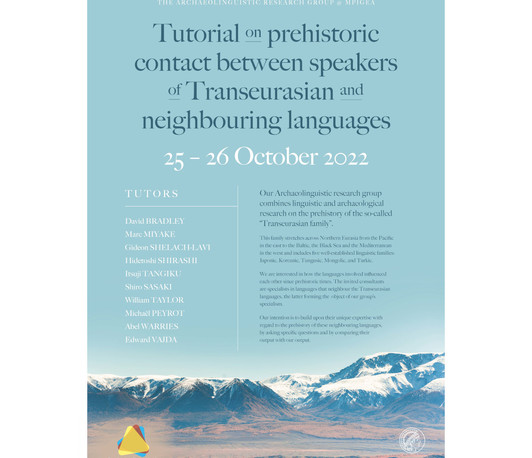
Tutorial on prehistoric contact between speakers of Transeurasian and neighbouring languages

  • Start: Oct 25, 2022 09:00 AM (Local Time Germany)
  • End: Oct 26, 2022 04:00 PM
  • Location: MPI of Geoanthropology
  • Room: Villa V14 and Zoom
  • Host: Martine Robbeets & Archaeolinguistic Research Group
  • Contact: robbeets@shh.mpg.de

Holocene human-environmental interactions and seismic activity in a Late Bronze to Early Iron Age settlement center in the southeastern Caucasus

Guest talk and Q&A with Dr. Hans von Suchodoletz
  • Date: Jun 23, 2022
  • Time: 02:00 PM - 03:00 PM (Local Time Germany)
  • Speaker: Dr. Hans von Suchodoletz, Research Fellow, Institute of Geography, University of Leipzig
  • Location: Hybrid
  • Room: Villa V14 and Zoom
  • Host: IMPRS-SHH
  • Contact: quante@shh.mpg.de

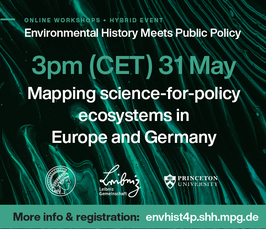
Mapping science-for-policy ecosystems in Europe and Germany

  • Date: May 31, 2022
  • Time: 03:00 PM (Local Time Germany)
  • Speaker: Irene Broer
  • Leibnitz Institute for Media Research – Hans Bredow Institute, Germany
  • Location: Online
  • Host: Palaeo-Science and History Group (PS&H)
  • Contact: izdebski@shh.mpg.de
How does scientific expertise make its way into policy decisions? In this webinar, we present and compare existing science-for-policy mechanisms in Europe, before taking a deep-dive into Germany’s multilevel ecosystem. The participants will gain insight into different types of science-for-policy mechanisms ranging from ad-hoc crisis teams to formalized and long-term advisory bodies. [more]

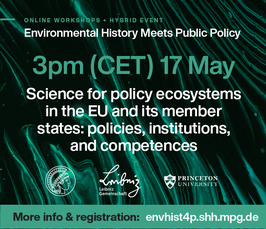
Science for Policy Ecosystems in the EU and Its Member States: Policies, Institutions, and Competences

  • Date: May 17, 2022
  • Time: 03:00 PM (Local Time Germany)
  • Speaker: Kristian Krieger
  • Policy Analyst, Unit: “Knowledge for Policy: Concepts and Methods”, European Commission, Joint Research Centre
  • Location: Online
  • Host: Palaeo-Science and History Group (PS&H)
  • Contact: izdebski@shh.mpg.de
Kristian Krieger will introduce the concept of a science for policy ecosystem to capture science advisory norms, processes, structures, and practices at EU and national levels more comprehensively. On this basis, he will elaborate on the JRC’s activities to strengthen and connect such ecosystems across Europe and identify opportunities for individual researchers/research groups to connect their research to these ecosystems and policymaking processes. [more]

The Key Role of the European Parliament Intergroup on ‘Climate Change, Biodiversity & Sustainable Development’ (Ccbsd) In Bridging the Science-policy Nexus

  • Date: May 3, 2022
  • Time: 03:00 PM (Local Time Germany)
  • Speaker: Ilias Grampas
  • Deputy Director, European Bureau for Conservation and Development (EBCD)
  • Location: Online
  • Host: Palaeo-Science and History Group (PS&H)
  • Contact: izdebski@shh.mpg.de
Recognizing that a sustainable world needs to ensure human well-being, nature protection and economic prosperity for present and future generations, the European Parliament Intergroup on “Climate Change, Biodiversity and Sustainable Development” aims to look into solutions and opportunities linked with today’s and tomorrow’s environmental and socio-economic challenges, as well as to guide the development and implementation of coherent sustainable policies based on scientific evidence. Therefore, this session will focus on the mission, vision and key priorities of the European Parliament Intergroup on “Climate Change, Biodiversity and Sustainable Development”, as a multi-stakeholder platform of dialogue, which brings together Members of the European Parliament (MEPs) from all political groups and Parliamentary Committees with representatives of the European Commission, Presidency of the Council of the EU, Member States and key stakeholders, such as NGOs, private sector and industry representatives, scientists, experts, and civil society. [more]
Recoverability of ancestral recombination graph topologies

Virtual seminar series: Horizontal evolutionary processes in phylogenetics: Virtual seminar series: Horizontal evolutionary processes in phylogenetics
  • Date: Apr 26, 2022
  • Time: 02:00 PM - 03:00 PM (Local Time Germany)
  • Speaker: Elizabeth Hayman
  • University of Oxford
  • Location: Online
  • Host: TIDE, Denise Kühnert
  • Contact: tide-seminars@shh.mpg.de
Ancestral recombination graphs (ARGs) are the extension of phylogenetic trees to include recombination, a powerful evolutionary process that shapes the genetic diversity of many species. The topology of this graph gives us important information on the evolution of a species, but algorithms to reconstruct an ARG from species data are often reliant on sample sequences carrying informative patterns of mutations.In this talk I will present exact results concerning the probability of recovering the true topology of an ARG under the coalescent with recombination and gene conversion. These expressions give us an indication of the uncertainty in reconstructed ARGs, and we see that for parameter values realistic for biological species (in particular SARS-CoV-2), the probability of reconstructing genealogies that are close to the truth is low. This is joint work with Anastasia Ignatieva and Jotun Hein (https://arxiv.org/abs/2110.04848). [more]

Engaging with Government: History as Part of Policy Making

Environmental History for Public Policy
  • Date: Apr 19, 2022
  • Time: 03:00 PM (Local Time Germany)
  • Speaker: Prof. Philip Murphy
  • History and Policy Group, UK
  • Location: Online
  • Host: Palaeo-Science and History Group (PS&H)
  • Contact: izdebski@shh.mpg.de
In 2002, a group of scholars established History & Policy, a network of academic historians dedicated to the principle that access to historical knowledge and expertise can make for better policy-making. The current director of History & Policy, Philip Murphy, explores this relationship and its implications for the ways academics interact with government. What are the incentives for historians to engage with governments? Conversely, with a rapid turn-around in staff and the move to digital communication, the challenge for departments in preserving and accessing ‘institutional memory’ is greater than ever. Yet the pressures of contemporary policy-making leave officials with little time to absorb conventional historical outputs. How can and should these outputs be repurposed to make them more policy-relevant? And finally, what are the implications of the rise of populism and the resurgence of ‘culture wars’ for the relationship between historians, politics and the state? [more]

Science for Policy Communication

Environmental History for Public Policy
  • Date: Apr 5, 2022
  • Time: 03:00 PM (Local Time Germany)
  • Speaker: Vitalba Crivello
  • Policy Analyst at the European Science-Media Hub, STOA/DG EPRS, European Parliament
  • Location: Online
  • Host: Palaeo-Science and History Group (PS&H)
  • Contact: izdebski@shh.mpg.de
Vitalba Crivello will talk about the experience of the European Science-Media Hub, the platform of the European Parliament communicating sound science to the public. The Hub brings together scientists and media makers to work in an open, collaborative way, notably producing evidence-based information to engage with citizens and other ‘users’ of scientific data/results/approaches. On the basis of this experience, Vitalba will offer some examples and draw some conclusions on how to successfully communicate science for policy, with a special attention to environmental topics [more]

Introduction to Science for Policy

Environmental History for Public Policy
  • Date: Mar 22, 2022
  • Time: 03:00 PM (Local Time Germany)
  • Speaker: Chloe Hill, Policy Officer, European Geosciences Union
  • Location: Online
  • Host: Palaeo-Science and History Group (PS&H)
  • Contact: izdebski@shh.mpg.de

The influence of reassortment on viral fitness and host switching

Virtual Seminar Series: Horizontal evolutionary processes in phylogenetics: Virtual seminar series: Horizontal evolutionary processes in phylogenetics
  • Date: Mar 15, 2022
  • Time: 02:00 PM - 03:00 PM (Local Time Germany)
  • Speaker: Ugne Stolz (ETH Zürich, Switzerland)
  • Location: Online
  • Host: TIDE, Denise Kühnert
  • Contact: tide-seminars@shh.mpg.de
Reassortment is a form of recombination in viruses with segmented genomes, such as influenza. It is characterized by different viral strains exchanging their segments upon the co-infection of a single host cell. Therefore, the shared history of such viruses has to be depicted by a network, not a tree. In this talk Ugne Stolz will present a coalescent with reassortment (CoalRe) package for the inference of such networks from the genetic sequence data and its extension SCoRe which allows for population structure. Stolz will discuss extensions to the classic coalescent framework and how these packages can be used in order to explore reassortment influence on viral fitness and jumps between different host types. [more]

Screening for recombination in large data sets: sensitivity, specificity, and applications to coronaviruses

Virtual seminar series: Horizontal evolutionary processes in phylogenetics
  • Date: Feb 15, 2022
  • Time: 04:00 PM - 05:00 PM (Local Time Germany)
  • Speaker: Associate Professor Maciej Boni (Pennsylvania State University)
  • Location: Online
  • Host: TIDE, Denise Kühnert
  • Contact: tide-seminars@shh.mpg.de
Over the past 35 years many statistical and bioinformatic tools have been developed to detect recombination, gene conversion, or horizontal gene transfer in sequence data. Five separate statistical signals have been commonly used to detect recombinant sequences, and two of these - mosaic signals and phylogenetic incongruence signals - have emerged as the preferred methods for generating evidence for recombination. I will review the derivation of a non-parametric mosaic statistic called Delta_mn2 that forms the basis of the 3SEQ recombination detection algorithm. The sensitivity, specificity, and exact p-values reported by 3SEQ give it some advantages as a screening tool for recombination in large data sets. I will show how to derive clonal subsegments, or breakpoint-free regions (BFRs), using this approach. And I will show how we have used this screening approach inidentifying recombinants in sarbecoviruses and SARS-CoV-2. [more]

Building and using dated phylogenies in the presence of bacterial recombination

Virtual seminar series: Horizontal evolutionary processes in phylogenetics
  • Date: Jan 18, 2022
  • Time: 02:00 PM - 03:00 PM (Local Time Germany)
  • Speaker: Professor Xavier Didelot (The University of Warwick, UK)
  • Location: Online
  • Host: TIDE, Denise Kühnert
  • Contact: tide-seminars@shh.mpg.de
Go to Editor View